
AI vs Machine Learning vs Deep Learning vs Generative AI: How They Fit Together
Artificial intelligence (AI) is the broad goal of making computers do tasks that normally need human intelligence. Machine learning (ML) is the part of AI where systems learn patterns from data instead of following hand-written rules. Deep learning is the part of ML that uses large neural networks. Generative AI is the part of deep learning that creates new content, such as text, images or code.
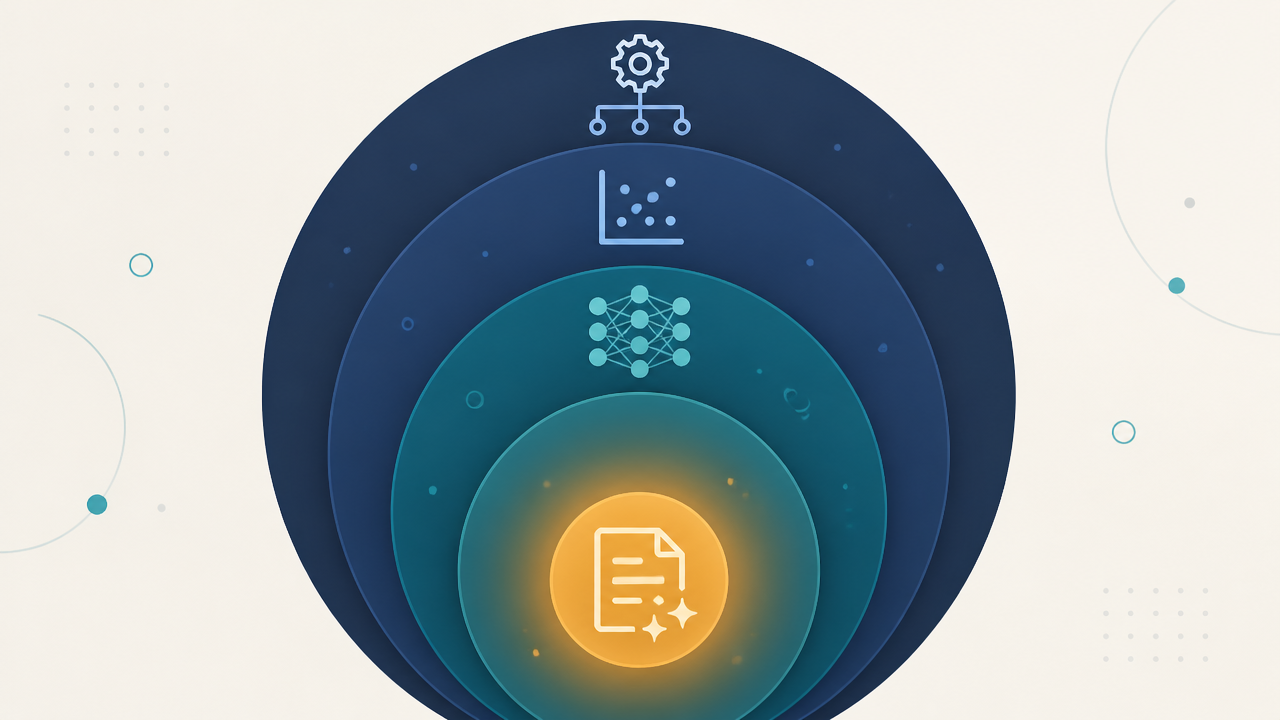
Many people use these four terms as if they meant the same thing, and that makes it hard to choose a course or to judge what a vendor is actually selling. It helps to picture them as nested circles: each term sits inside the one before it. To make each layer concrete, this article follows one bank through all four.
The Nested View
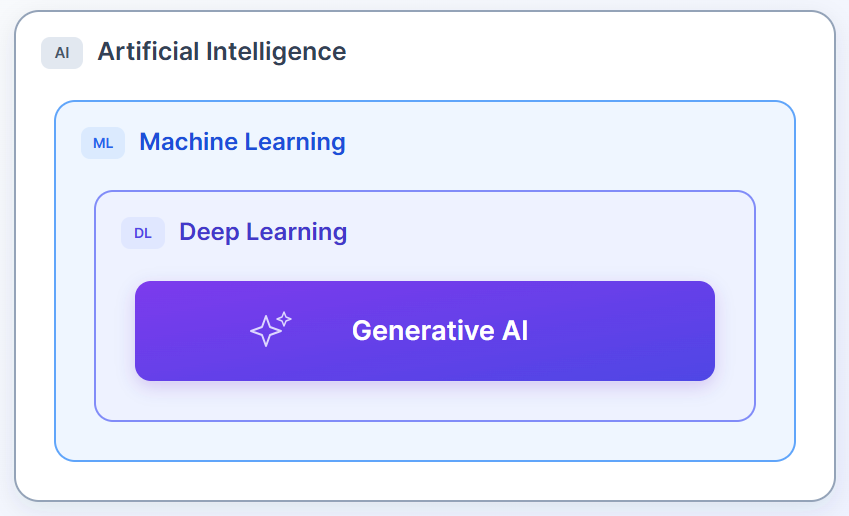 All generative AI is deep learning, and all deep learning is machine learning. The reverse doesn't hold: most machine learning in production today isn't deep learning, and most deep learning doesn't generate anything.
Layer 1: Artificial Intelligence
AI is the whole field. The term dates back to a 1956 workshop at Dartmouth, and for decades most AI systems were rule-based: humans wrote the logic by hand ("if X and Y, then Z").
At the bank: a fraud rule that says "block any card transaction over $5,000 made in a different country within an hour of a domestic purchase". It counts as AI because it automates a judgment call. It isn't machine learning, because a person wrote the rule and it never learns anything.
Rule-based systems are still everywhere, because they're predictable, easy to audit and cheap to run. Their weakness is that someone has to anticipate every pattern in advance, and fraudsters change tactics faster than people can write new rules.
Layer 2: Machine Learning
Machine learning flips the approach. Instead of writing rules, you give the system examples with known outcomes and let an algorithm work out the patterns. Arthur Samuel popularized the term in 1959, describing it as giving computers the ability to learn without being explicitly programmed.
At the bank: a credit scoring model trained on thousands of past loans, where the bank knows which borrowers repaid and which defaulted. The model learns how income, debt ratio, payment history and dozens of other variables combine to predict default risk, and it picks up interactions no analyst would have written as a rule.
Classic ML works best on structured, tabular data: rows and columns like a spreadsheet. Its main algorithms are linear and logistic regression, decision trees, random forests and gradient boosting. These methods still power much of the real business value in AI: pricing, churn prediction, demand forecasting and risk scoring. They're also the "predictive" step in the four types of data analytics.
Layer 3: Deep Learning
Deep learning uses artificial neural networks with many layers, which is where the "deep" comes from. Its big advantage is that it can learn directly from unstructured data like images, audio and free text, where classic ML needs a person to turn the raw data into useful features first.
Deep learning took off around 2012, when a neural network called AlexNet won a major image recognition competition by a large margin. Better GPUs and much larger datasets made it practical from then on.
At the bank: a model that reads scanned cheques and ID documents, pulling out handwriting, signatures and faces. You can't do this well with a spreadsheet of hand-made features, but a deep network trained on millions of images learns it directly.
The trade-offs: deep learning needs much more data and computing power, and it's harder to explain why the model made a decision. That matters for regulated decisions like credit, which is one reason banks often keep classic ML for scoring.
Layer 4: Generative AI
Generative AI is deep learning that produces new content instead of labeling or scoring existing content. Today's large language models (LLMs) are built on the transformer architecture, which Google researchers introduced in 2017. ChatGPT's launch in November 2022 brought generative AI to the mainstream.
At the bank: an assistant that drafts replies to customer complaints and summarizes long case files for staff. It generates fluent text based on patterns learned from huge amounts of writing.
Its main weakness is that it can produce confident, wrong answers (often called "hallucinations"). That's why serious applications combine it with retrieval of trusted documents (RAG), human review, or both.
The Four Layers at a Glance
| AI (rule-based) | Machine learning | Deep learning | Generative AI | |
|---|---|---|---|---|
| How it works | Humans write rules | Learns patterns from labeled examples | Neural networks with many layers | Deep models that produce new content |
| Best data type | Any, if rules are clear | Structured / tabular | Images, audio, text | Text, images, code |
| Bank example | Fraud rule | Credit scoring | Cheque and ID reading | Drafting customer replies |
| Explainability | High | Medium to high | Low | Low |
| Data needed | None to train | Thousands of rows+ | Often millions of examples | Pre-trained by vendors; you adapt it |
| Typical tools | Business rules engines, SQL | scikit-learn, XGBoost | PyTorch, TensorFlow | LLM APIs, LangChain, LlamaIndex |
Where Do AI Agents Fit?
AI agents aren't a fifth circle. They're a way of using generative AI: an LLM that plans steps, calls tools (search, databases, code) and acts on the results instead of only answering one question. We cover the difference in detail in Generative AI vs Agentic AI.
Common Misconceptions
"If it's not ChatGPT-like, it's not real AI." Most AI value in business still comes from classic machine learning on tabular data. A churn model built with gradient boosting is as much "AI" as a chatbot, and usually far easier to measure in revenue.
"Deep learning is always better." On tabular business data, well-tuned gradient boosting often matches or beats neural networks while being faster, cheaper and easier to explain. Choose deep learning for unstructured data, not by default.
"Generative AI replaces the other layers." It adds a new capability. A bank still needs its credit model, its fraud rules and its document reader. The assistant sits alongside them.
"You have to learn them in order." Not strictly. A business user can learn to use generative AI productively without studying machine learning. But anyone who wants to build AI systems benefits from ML fundamentals first, as we argue in Do You Need a Machine Learning Background to Build LLM Apps?.
What This Means for Your Learning Path
- You want to use AI at work, not build it: start with a non-technical overview like AI For Everyone, then follow our AI learning path for business leaders.
- You want to build predictive models: start with classic ML. The Machine Learning Specialization (Stanford / DeepLearning.AI) is the standard entry point. Check how much math you need first.
- You want to build generative AI applications: follow our generative AI learning path. It moves from LLM basics to RAG and agents.
Browse all options in our Artificial Intelligence courses.
Frequently Asked Questions
Is machine learning the same as AI? No. Machine learning is one approach to AI, the one where systems learn from data. AI also includes rule-based systems, search and planning methods that don't learn from data.
Is ChatGPT machine learning or deep learning? Both, plus generative AI. ChatGPT is a large language model, which is a deep neural network (a transformer) trained with machine learning methods. It sits in the innermost circle.
Which should I learn first, machine learning or deep learning? Machine learning. Deep learning concepts like loss functions, overfitting and train/test splits all build on ML fundamentals, and many jobs need only classic ML.
Is data science the same as AI? They overlap but aren't the same. Data science is about extracting insight from data and uses statistics, analysis and often machine learning. AI is about systems that perform intelligent tasks. A data scientist may build ML models, but much of the job is analysis and communication.
Bottom Line
Think of the four terms as nested circles: AI is the goal, machine learning is learning from data, deep learning is ML with large neural networks, and generative AI is deep learning that creates content. Most business value still comes from the middle layers, while generative AI is the fastest-growing. Choose your learning path based on whether you want to use AI, build predictive models, or build generative applications.