Generative AI vs Agentic AI: What Is the Difference and What Should You Learn?
These terms get used interchangeably in casual conversation, but they describe genuinely different capabilities — and knowing the difference matters for deciding what to learn next.
The Core Difference
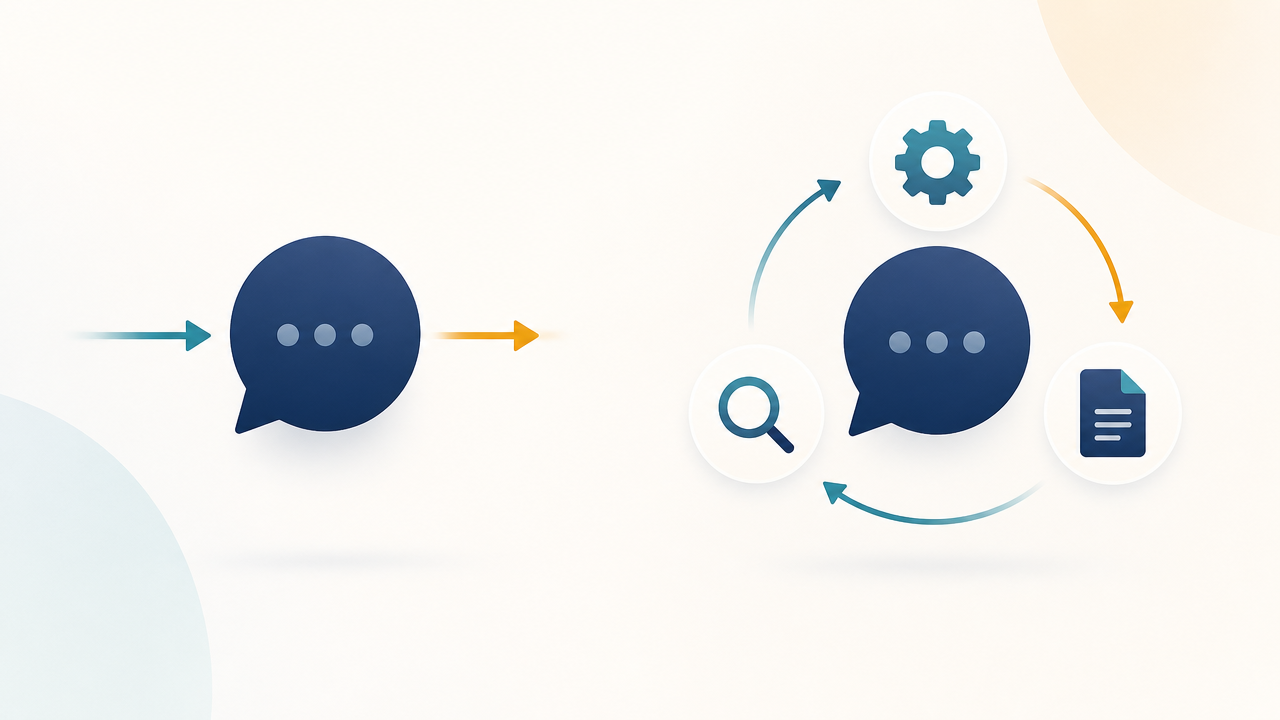
Generative AI creates content — text, images, code — in response to a request. You ask, it generates, the interaction ends. ChatGPT answering a question is generative AI: input in, output out, done.
Agentic AI takes generative AI and adds autonomy: the ability to plan multi-step tasks, use tools, take actions in the world (searching the web, calling APIs, executing code), observe results, and adjust its approach based on what it finds — often without a human approving each individual step.
A Concrete Example of the Difference
Ask a generative AI tool to "write a summary of recent news about a topic," and it generates a summary based on what it already knows — a single request, a single response. Ask an agentic AI system the same request, and it might autonomously search the web for current articles, read several of them, synthesize the findings, and produce a summary grounded in what it just found — multiple steps, tool use, and adaptation, without you approving each individual search.
Why This Distinction Matters for What You Learn
Generative AI skills (prompting, RAG, working with LLM APIs) are the foundation — you genuinely need them before agentic AI makes sense, since agents are built on top of the same underlying models. But agentic AI adds a distinct additional layer: agent architectures, tool-calling patterns, memory across multi-step tasks, and — critically — the safety and control mechanisms needed when a system can take real actions rather than just generate text.
What to Learn for Generative AI
Prompting technique, retrieval-augmented generation (RAG), working directly with LLM APIs, and basic application patterns like chatbots and document Q&A systems. See our Generative AI with Large Language Models for a technically substantial starting point, or our broader Generative AI Learning Path for the full sequence.
What to Learn for Agentic AI
Agent architectures and reasoning loops, tool and function calling, memory management across multi-step tasks, multi-agent coordination patterns, and — importantly — the guardrails and control mechanisms that prevent an autonomous system from taking costly or harmful actions unsupervised. This is a meaningfully more advanced layer, and it assumes the generative AI foundation is already solid. The Udacity Agentic AI Nanodegree is built specifically around this layer.
The Risk Profile Is Genuinely Different
This is worth taking seriously, not just as a technical footnote: an agent that can execute code, spend money via an API, or send real emails carries risks a pure text-generation system doesn't — errors compound across steps, and a subtly wrong decision early in a multi-step task can cascade into a much bigger problem than a single bad text response would. Anyone building agentic systems needs to learn error handling, cost controls, and human-in-the-loop checkpoints as a core skill, not an afterthought.
A Reasonable Learning Sequence
Generative AI fundamentals first — prompting, RAG, LLM API basics. Don't skip this even if agents are your real interest; agent systems are built on this foundation and debugging an agent without understanding the underlying model is much harder.
Simple, single-tool agent patterns — a system that can search the web or query one API, with human approval before taking any consequential action.
Multi-step, multi-tool agents — more complex reasoning chains, once you're comfortable with the basics and the failure modes involved.
Production safety and control mechanisms — this stage is often skipped by self-taught learners and is exactly where real agent deployments succeed or fail. See our piece on why most AI agents fail in production for the specifics.
Frequently Asked Questions
Can I learn agentic AI without learning generative AI fundamentals first?
Technically you can jump straight to agent frameworks, but you'll struggle to debug unexpected behavior without understanding what the underlying language model is actually doing — the foundation pays off quickly.
Is agentic AI just generative AI with extra steps?
Conceptually related, but the added autonomy, tool use, and multi-step reasoning genuinely change the engineering challenges involved — particularly around reliability and safety, which barely matter for a single-turn generative interaction.
Which is the bigger career opportunity right now?
Agentic AI is newer and has less established course content and fewer experienced practitioners, which can mean more opportunity but also more uncertainty — see our piece on how to build your first AI agent if you're specifically interested in this direction.
Do I need both skill sets, or can I specialize in just one?
Most people building agents genuinely need both, since agents are generative AI systems with an autonomy layer on top — you can't skip the foundation.
Bottom Line
Generative AI creates content in response to a request; agentic AI adds autonomous, multi-step action-taking on top of that same underlying capability. Learn generative AI fundamentals first regardless of your end goal — agents are built on that foundation, not a separate track — then layer in agent architecture, tool use, and critically, safety and control mechanisms once the basics are solid.