LangGraph vs CrewAI vs AutoGen: Choosing an Agent Framework
Three of the most common frameworks for building AI agents take genuinely different approaches to the same underlying problem. Here's what actually differs between them, and how to pick a starting point.
The Core Difference in Philosophy
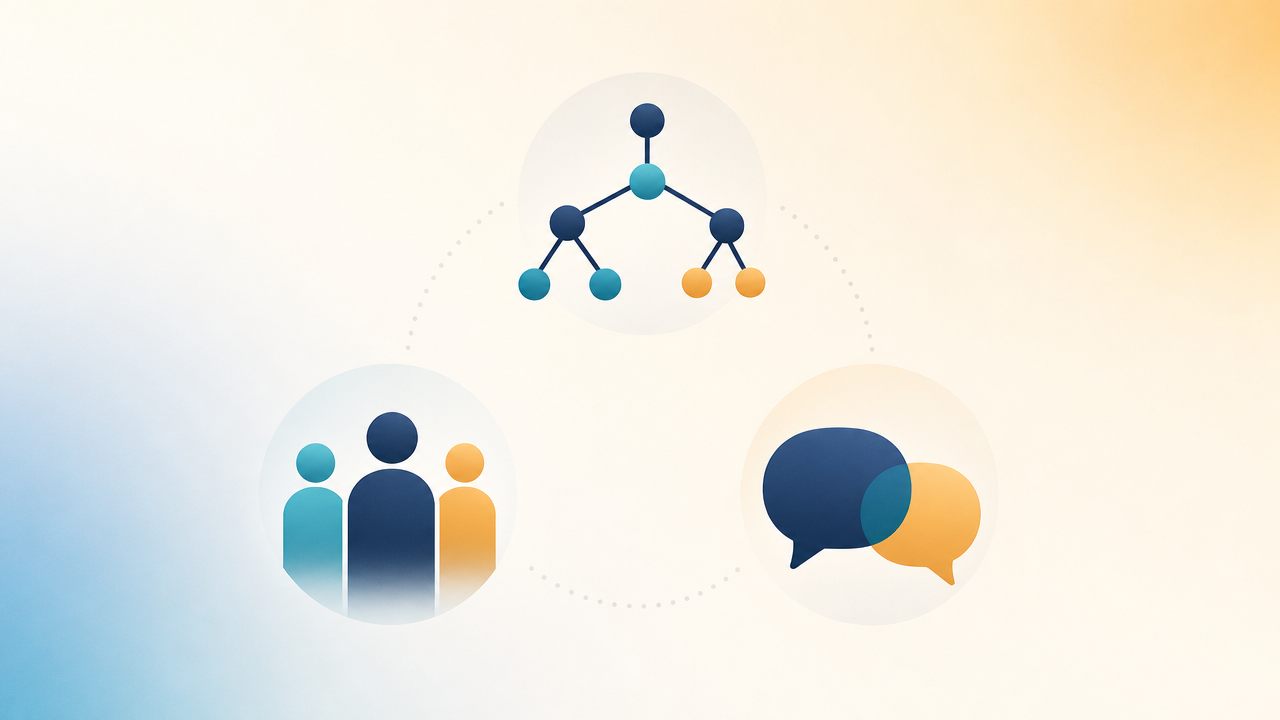
LangGraph (built by the LangChain team) models agent workflows as an explicit graph of states and transitions — you define the possible steps and how control flows between them. This gives you precise control over exactly what happens at each step, at the cost of more upfront design work.
CrewAI is built around a "team of agents with roles" metaphor — you define specialized agents (a researcher, a writer, a reviewer) with distinct roles and let them collaborate on a task, similar to organizing a human team. This is often more intuitive to reason about for multi-agent tasks specifically.
AutoGen (from Microsoft) focuses on conversational multi-agent patterns — agents that communicate with each other through structured conversation to solve a task, with strong support for human-in-the-loop checkpoints within that conversation flow.
Head-to-Head Comparison
LangGraph
CrewAI
AutoGen
Mental model
Explicit state graph
Team of role-based agents
Conversational multi-agent
Control precision
High — you define exact flow
Moderate — role-based delegation
Moderate — conversation-driven
Learning curve
Steeper, more explicit design
Gentler, intuitive team metaphor
Moderate, conversation patterns
Best for
Complex, precisely controlled workflows
Multi-agent collaboration tasks
Conversational agent-to-agent tasks
Ecosystem
Tightly integrated with LangChain
Growing, increasingly popular
Backed by Microsoft, strong docs
Where LangGraph Wins
You need precise control over exactly what happens at each step — for production systems where unpredictable agent behavior is a real risk, explicit graph-based control gives you more confidence about what can and can't happen.
You're already using LangChain for other parts of your application — LangGraph integrates naturally into that existing ecosystem.
Your workflow has complex conditional branching that's easier to reason about as an explicit graph than as an implicit conversation or role assignment.
Where CrewAI Wins
Your task naturally maps to a "team" structure — research, then writing, then review is a common pattern CrewAI's role-based design handles intuitively.
You want a gentler learning curve for a first multi-agent project — the team metaphor is often easier to reason about initially than an explicit state graph.
You're prototyping quickly and want to get a working multi-agent system running with less upfront design overhead.
Where AutoGen Wins
Your task is naturally conversational — agents negotiating, debating, or iterating together toward a solution through back-and-forth exchange.
You want strong human-in-the-loop support built into the conversation flow itself, useful for tasks where a human needs to periodically approve or redirect the agents' progress.
You value Microsoft's backing and documentation quality, which matters for teams wanting a framework with strong institutional support behind it.
A Practical Way to Choose
If you're building your first multi-agent system and want the gentlest on-ramp, start with CrewAI's team metaphor. If you need precise control for a production system where predictability matters more than ease of prototyping, LangGraph's explicit graph model is worth the steeper learning curve. If your task is fundamentally about agents talking to each other to solve something collaboratively, AutoGen's conversational design fits most naturally.
You Don't Have to Pick Forever
These frameworks solve overlapping problems with different design philosophies — trying one, hitting its limits, and switching to another as your understanding of the problem develops is a completely normal part of learning this space, not a sign you chose wrong the first time.
Frequently Asked Questions
Which framework is most popular right now?
Popularity shifts quickly in this space — rather than chasing the most popular option, match the framework to your task's natural structure using the guidance above.
Do I need to learn all three eventually?
Not necessarily — most practitioners develop real depth in one or two based on the kinds of projects they actually work on, rather than mastering all three equally.
Which is best for a genuinely simple, single-agent project?
None of these three are strictly necessary for a simple single-agent system — see our How to Build Your First AI Agent roadmap, which starts simpler before introducing any of these frameworks.
Is Microsoft's AutoGen only for Azure users?
No — it's usable independent of Azure, though some enterprise integration features may be more relevant if you're already in that ecosystem.
Bottom Line
LangGraph gives you the most precise control at the cost of a steeper learning curve; CrewAI offers the gentlest on-ramp for team-structured multi-agent tasks; AutoGen fits naturally when your problem is fundamentally conversational. Match the framework to your task's actual shape rather than picking based on which is trending — and don't be afraid to switch once you understand your problem better.