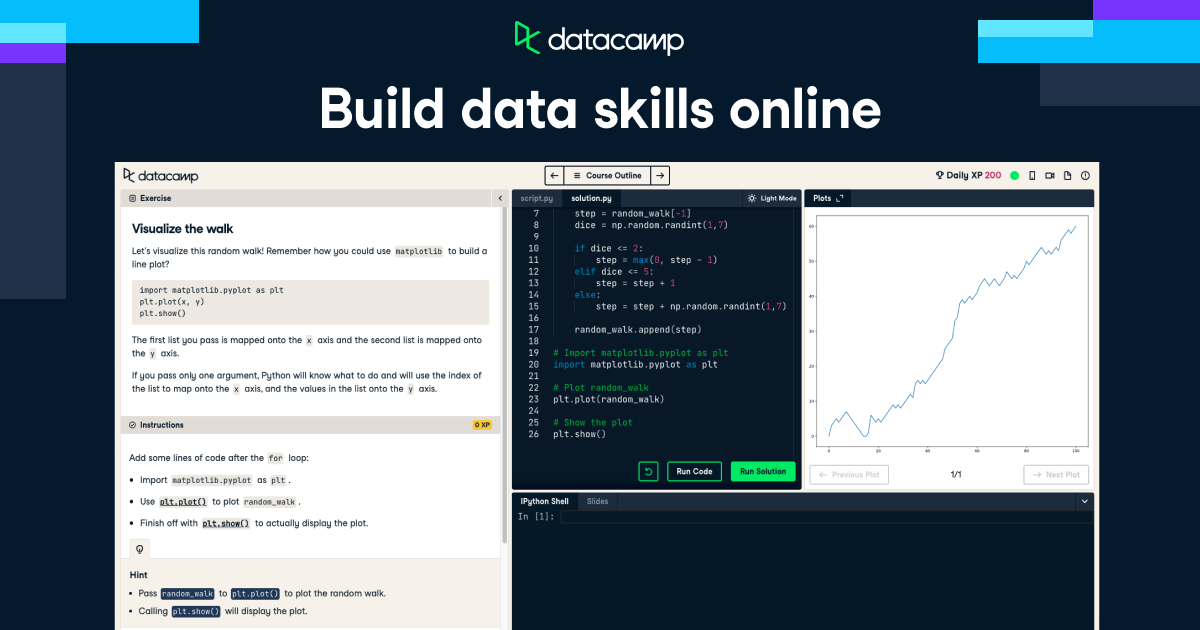
Path Overview
This DataCamp track is built for someone who wants to go from zero Python knowledge to being able to actually do data science work — pulling in messy data, cleaning it, visualizing it, running statistical tests, and building machine learning models. It's structured as a ladder: each course assumes you've absorbed the one before it, so by the end you're not just reciting syntax, you've handled things like regression analysis, hypothesis testing, and tree-based models. The track also doubles as prep material for DataCamp's Associate Data Scientist in Python certification exam, so if that credential matters to you, the curriculum maps directly onto it.
What's Included in This Path
The 23 courses are organized into a few clear phases:
- Python fundamentals — Introduction to Python, Intermediate Python, Introduction to Functions in Python, Python Toolbox, Writing Functions in Python
- Data wrangling — Data Manipulation with pandas, Joining Data with pandas, Cleaning Data in Python, Working with Dates and Times in Python, Introduction to Importing Data in Python
- Visualization and categorical data — Introduction to Data Visualization with Matplotlib, Introduction to Data Visualization with Seaborn, Working with Categorical Data in Python, Data Communication Concepts
- Statistics — Introduction to Statistics in Python, Exploratory Data Analysis in Python, Sampling in Python, Hypothesis Testing in Python, Experimental Design in Python, Introduction to Regression with statsmodels in Python
- Machine learning — Supervised Learning with scikit-learn, Unsupervised Learning in Python, Machine Learning with Tree-Based Models in Python
Interspersed between these are ten bonus hands-on projects (Netflix movie data, NYC school test scores, Nobel Prize winners, LA crime data, Airbnb pricing trends, car insurance claims, soccer match statistics, crop prediction, penguin clustering, and DVD rental duration prediction) plus three standalone skill assessments covering data manipulation, data importing/cleaning, and general Python programming.
Skills You Will Build
- Writing clean, reusable Python functions and handling errors properly
- Importing data from Excel, SQL, SAS, and web sources, then cleaning it
- Manipulating and merging datasets with pandas
- Building visualizations in Matplotlib and Seaborn, including with categorical data
- Running statistical tests — t-tests, chi-square tests, proportion tests
- Designing experiments and interpreting regression models with statsmodels
- Training supervised and unsupervised models, including tree-based ensembles, with scikit-learn
Who Is This Path For?
This fits people starting from genuinely zero Python experience — the first two courses treat you like you've never written a line of code. It also works for someone who already knows basic Python syntax but wants a structured route into statistics and machine learning rather than jumping straight into advanced ML courses. If you already have solid pandas and scikit-learn experience, large stretches of this track will feel like review, and you'd be better served picking individual advanced courses instead.
Time Commitment & Certificate
DataCamp states the track runs about 90 hours total, which at a casual pace (a few hours a week) stretches into several months, though it's entirely self-paced with no deadlines. Finishing the track earns a Statement of Accomplishment you can add to LinkedIn or a resume. Completing the courses also prepares you for DataCamp's separate Associate Data Scientist in Python certification exam, which is the credential actually tied to industry recognition — the Statement of Accomplishment alone is more of a completion marker than a verified skills credential.
Pros and Cons
Pros
- Logical progression from absolute basics through to machine learning, with no gaps in the chain
- Ten real-dataset projects give you a portfolio, not just completed quizzes
- Covers both the statistics side (hypothesis testing, experimental design) and the ML side, which many Python tracks skip
- Built-in skill assessments let you check retention before moving on
Cons
- 90 hours is a rough estimate; anyone who gets stuck on debugging or wants to actually understand concepts (versus just finishing exercises) will likely spend more
- The certification that actually carries weight with employers is a separate, paid exam — this track alone issues a lower-value completion certificate
- No live instruction or cohort — if you learn better with deadlines or peer feedback, this format won't give you that
- Covers a broad toolset shallowly in places; some courses (like statsmodels regression) move fast and assume you'll practice independently afterward
FAQ
Do I need coding experience before starting? No — the track states there are no prerequisites, and the first two courses are built for complete beginners.
How long does it realistically take? DataCamp lists 90 hours, but that's course-video-and-exercise time only; expect more if you want to retain the material rather than skim it.
Is the certificate worth something on a resume? The completion Statement of Accomplishment mainly shows you finished the material. The separately earned Associate Data Scientist in Python certification exam is the credential more likely to be recognized by employers.
How is this different from just taking Supervised Learning with scikit-learn on its own? That single course assumes you already know pandas and basic statistics — this track builds that foundation first, which matters if you're starting from scratch.
Check the current course list and pricing directly on DataCamp's track page before enrolling, since course details can shift over time.