Course Overview
This course walks you through the mechanics of LangChain agents — systems that combine a language model, a set of tools, and a reasoning loop to complete multi-step tasks on their own. You start by wiring up an agent using the ReAct (Reasoning and Action) pattern with OpenAI's API, then move into writing your own custom tools, including one that handles math calculations the LLM can't reliably do on its own.
From there, the course shifts into LangGraph, where you represent agent logic as a graph of nodes and edges instead of a single linear chain. You'll build a chatbot that can call a Wikipedia tool for live lookups, add memory so it remembers earlier turns in a conversation, and eventually combine several tools into one chatbot that decides which tool to call and when. By the end, you're not just using a prebuilt agent — you're assembling the decision logic yourself.
What You Will Learn
- How prompts, LLMs, and tools fit together in the ReAct framework
- Building and registering custom tools for an agent (e.g., a math tool)
- Running conversations with a ReAct agent and querying conversation history
- Defining graph states, nodes, and edges in LangGraph
- Connecting an external API (Wikipedia) as a callable tool
- Adding and using memory so a chatbot retains context across turns
- Binding multiple tools to one agent and routing between them
- Writing functions that control when the chatbot stops or calls an LLM
- Visualizing the resulting graph/workflow
Course Structure
- Chapter 1 — The Essentials of LangChain Agents: ReAct agents, custom tools, conversation setup
- Chapter 2 — Building Chatbots with LangGraph: graph states, nodes/edges, Wikipedia tool integration, memory
- Chapter 3 — Build Dynamic Chat Agents: multiple tools, conditional function calling, multi-turn memory management
Who Is This Course For?
This is aimed at people who already have some LangChain exposure and want to move from "using an LLM chain" to "designing an agent that makes decisions." If you've never touched LangChain before, the listed prerequisite (Developing LLM Applications with LangChain) suggests you should take that first — this course assumes you're already comfortable with basic LangChain concepts. It's a reasonable fit for data scientists, AI engineers, or developers who want practical exposure to agent orchestration rather than deep theory on how LLMs reason internally.
Format & Time Commitment
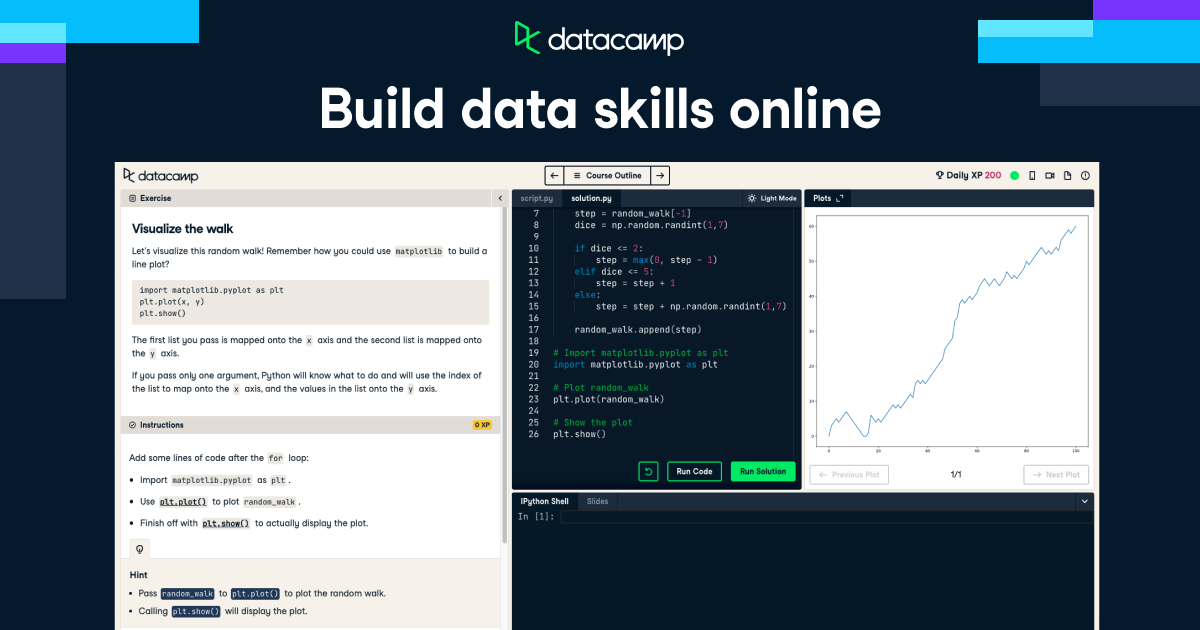
It's self-paced, built from 11 videos and 34 coding exercises, totaling around 3 hours. The format is DataCamp's usual pattern: short video, then an in-browser coding exercise, repeated through 3 chapters.
Pros and Cons
Pros
- Short and focused — you can realistically finish it in a few sessions
- Covers both the ReAct agent pattern and LangGraph, so you see two different ways of structuring agent logic
- Includes a real external tool integration (Wikipedia API), not just toy examples
- Practice-heavy format (34 exercises against 11 videos) means more doing than watching
Cons
- Requires prior LangChain knowledge — not beginner-friendly if you skip the prerequisite
- At 3 hours, it's a fairly shallow pass through agent design; don't expect production-grade patterns for error handling, cost control, or security
- Locked into DataCamp's subscription or per-course pricing model, so standalone cost isn't shown on the course page itself
- Tool coverage is limited to the examples shown (math tool, Wikipedia) — you'll need to adapt the patterns yourself for other APIs
FAQ
Do I need prior experience with LangChain?
Yes — the course lists "Developing LLM Applications with LangChain" as a prerequisite, so you should already understand basic LangChain concepts before starting.
Will I get a certificate?
Yes, you receive a Statement of Accomplishment upon completion, which you can add to LinkedIn or a resume.
Is this course mostly theory or hands-on coding?
It's heavily hands-on — 34 exercises paired with 11 videos across 3 chapters, so most of your time is spent writing and running code.
What if I want broader LangChain coverage, not just agents?
This course sits inside DataCamp's "Developing Applications with LangChain" track, so if you want the fuller picture beyond agents specifically, that track is the broader option to look at.
Check out the official course page on DataCamp to see the current syllabus and enroll.