Course Overview
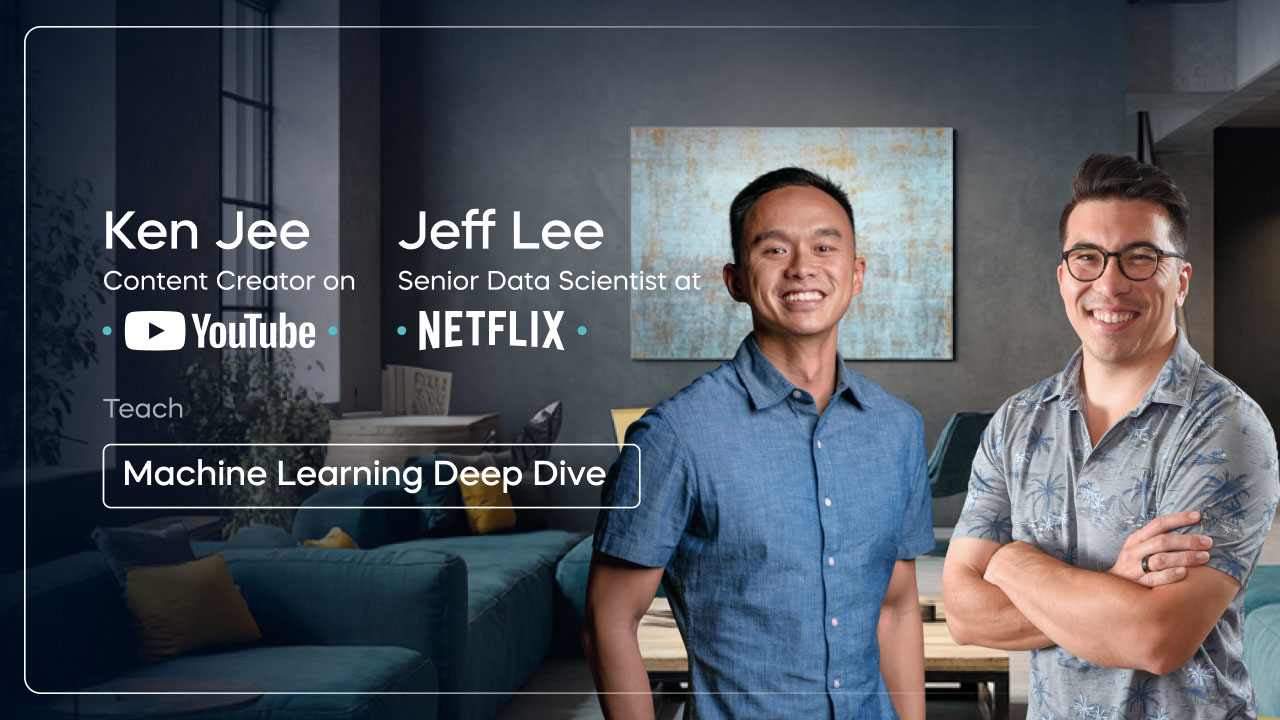
This is the third installment in a series by Ken Jee and Jeff Li. The earlier courses covered how the ML workflow runs and how the main algorithms work. This one asks a different question: where does each method pay off in a real organization, and what does it look like to build one yourself?
The first part is a set of short business-focused lessons. It covers simpler, data-light methods such as linear regression, logistic regression and SVMs, then moves to heavier use cases involving neural networks and collaborative filtering. The second, much larger part is a set of coding walkthroughs. Jeff Li, a senior data scientist at Netflix, builds models step by step and shows how he debugs and reasons through problems. You finish with a clearer sense of how to match an algorithm to a business situation, and you've watched the full process in code.
What You Will Learn
- Which algorithms suit which business problems, and why a simple model is sometimes the smarter choice
- How data preprocessing, exploratory analysis and feature engineering feed into a working model
- Model evaluation and cross-validation, including how to handle imbalanced data
- How to build ML algorithms in Python by following an experienced practitioner
- Debugging habits and problem-solving approaches for messy real-world ML work
- How a collaborative filtering approach and neural network use cases fit into business settings
Course Structure
| Section |
Length |
| 1. ML Business Use Cases |
27 min |
| 2. Coding Walkthroughs |
162 min |
| 3. Course Exam |
15 min |
The business section includes lessons on linear regression, logistic regression, random forest, K-means clustering, K-nearest neighbors and hierarchical clustering. These are available as free previews.
Who Is This Course For?
A good fit if you:
- Already understand ML basics and write Python comfortably
- Have taken a theory-focused course and want to see the ideas applied
- Want to learn by watching a professional work through a build
- Need CPE credits and a certificate for professional records
Look elsewhere if you:
- Are new to ML or Python. The course assumes you know both, so start with the prerequisite courses the provider recommends: Machine Learning in Python, The Machine Learning Process A-Z, and The Machine Learning Algorithms A-Z.
- Want deep mathematical treatment of the algorithms. The course focuses on application.
Format & Time Commitment
The course is self-paced and runs about three hours of video. The exercises and the exam add some time on top. Most people could finish it over a weekend, though following along in code and pausing to experiment will take longer. The provider classifies it as QAS self-study for CPE purposes.
Pros and Cons
Pros
- The business cases make clear why you'd pick one algorithm over another, which many technical courses skip.
- The coding walkthroughs take up most of the runtime. You watch real build decisions, not polished slides.
- Instructors have industry backgrounds. Jeff Li's experience includes forecasting work at Netflix and Spotify.
- It offers CPE-accredited credits, which is useful for professionals who track continuing education.
- Six lessons are free to preview, so you can judge the teaching style first.
- It earns strong ratings (4.9 from 870 reviews).
Cons
- It sits at an advanced level and builds on three earlier courses. Taking it alone may leave gaps.
- The setup is heavier than for a typical video course. You need a Pinecone account with an API key, plus a local Python environment.
- The business section is only 27 minutes. Each algorithm gets a brief treatment, so it's more of an overview than a deep case study.
- Walkthroughs are largely watch-and-follow. You'll need to add your own projects to retain the skills.
- The certificate comes with the Self-study plan, so it isn't available to free learners.
FAQ
How much does it cost?
Check the official page for current plan details. Some lessons are free to preview before you commit.
What do I need before starting?
Basic ML understanding and intermediate Python. You also need Python 3.8 or newer, a Pinecone account and API key, and an editor such as VS Code or Jupyter Notebook.
Is the certificate worth having?
It carries 4 CPE credits and is accredited, which matters for professionals who must log continuing education. For hiring purposes, a portfolio of projects will usually say more than any certificate.
What's a good alternative if I'm not ready?
Start with the three prerequisite courses the provider lists. They cover the ML process, the algorithms and Python implementation, and this course is built to follow them.
If you've already got the fundamentals down, try the free lessons on the official page to see whether the teaching style works for you.