Course Overview
This course walks through how machine learning gets applied inside the finance world, with a tight focus on using historical stock data to forecast price movement. You start by learning how to clean and structure raw stock data into features a model can actually use — things like moving averages and RSI — before fitting a straightforward linear model as your baseline. From there, the course layers in more sophisticated approaches so you can compare how different algorithms handle the same forecasting problem.
The back half shifts from "predict a single stock's price" to "build a smart portfolio." You'll use modern portfolio theory and the Sharpe ratio to evaluate risk-adjusted returns, then apply a random forest to generate portfolio predictions and judge whether the model's picks actually outperform a naive approach. The datasets aren't synthetic — you're working with real tickers like AAPL, AMD, SPY, and QQQ pulled from NASDAQ.
What You Will Learn
- Pulling moving averages, RSI, and volume-based features out of raw price data
- Fitting and evaluating a linear regression model on financial time series
- Building decision trees and random forests for price prediction, including hyperparameter tuning
- Using gradient boosting and interpreting feature importances
- Scaling data properly for KNN regression and neural networks
- Writing a custom loss function and fitting a neural net with it
- Reducing overfitting through dropout and model ensembling
- Calculating covariances, plotting an efficient frontier, and ranking portfolios by Sharpe ratio
- Using a random forest to predict which portfolios will perform best, then checking those predictions against actual returns
Course Structure
- Preparing data and a linear model — EDA, feature/target creation, first linear model
- Machine learning tree methods — decision trees, random forests, gradient boosting
- Neural networks and KNN — scaling, custom loss functions, dropout, ensembling
- Machine learning with modern portfolio theory — efficient frontiers, Sharpe ratios, ML-driven portfolio prediction
Who Is This Course For?
This fits best for someone who already has scikit-learn basics down and wants to see those skills applied to a finance-specific problem rather than a generic dataset. If you work in or around investing, trading, or quant-adjacent analytics and want a practical on-ramp to applying ML there, this hits the mark. If you've never built a model before, this isn't the entry point — the prerequisite course on supervised learning with scikit-learn is a real requirement, not a suggestion, since concepts like train/test splits and model fitting aren't re-taught here.
Format & Time Commitment
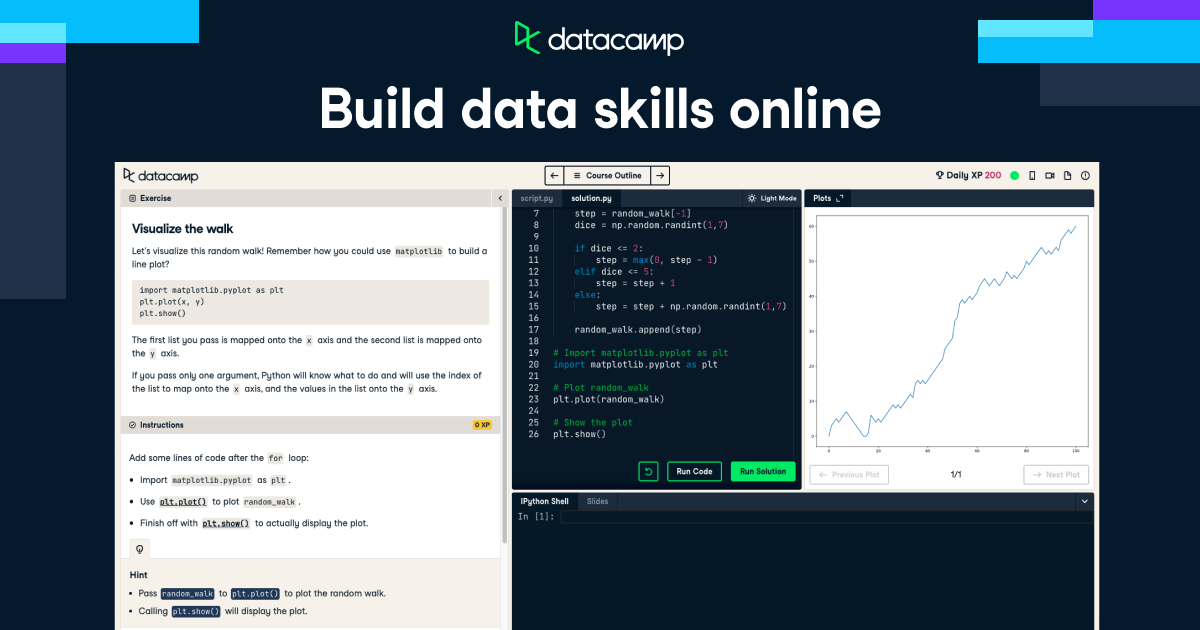
It's self-paced, built from 15 videos paired with 59 interactive coding exercises, and the whole thing is estimated at around 4 hours. That's compact enough to finish in a weekend, though the density of exercises means you're doing a lot of hands-on coding rather than passive watching.
Pros and Cons
Pros
- Covers a genuinely wide range of models (linear, tree-based, neural network) rather than just one technique
- Uses real NASDAQ datasets instead of toy data, which makes the exercises feel more applicable
- Ties machine learning directly to a finance concept (Sharpe ratio, MPT) instead of treating prediction as the only goal
- Strong rating (4.8 from 234 reviews) suggests consistent learner satisfaction
Cons
- Four hours is tight for the amount of ground covered — neural networks, tree ensembles, and portfolio theory each deserve more room than a single short course can give
- The scikit-learn prerequisite is a real barrier; skipping it will likely leave gaps in understanding core steps
- As with most short-form coding courses, you get breadth over depth — don't expect a deep dive into the math behind any one model
- No guarantee the trading strategies taught here translate into real-world profitability; it's an ML skills course, not a trading signal provider
FAQ
Does this course include a certificate?
Yes, you get a statement of accomplishment on completion, which you can add to LinkedIn or a resume.
Do I need prior ML experience?
Yes — the course explicitly lists "Supervised Learning with scikit-learn" as a prerequisite, so you should be comfortable with basic model fitting before starting.
What stock data will I actually work with?
The course uses real datasets including AAPL, SPY, AMD, SMLV, LNG, and QQQ pulled from NASDAQ.
Is this course enough to start algorithmic trading?
Not on its own — it teaches the ML techniques and portfolio evaluation methods, but it's focused on prediction and analysis skills rather than building a production trading system.
Curious whether this fits your current skill level? Take a look at the full curriculum on DataCamp's course page before enrolling.