Course Overview
This course takes you through the standard workflow for predicting outcomes from labeled data, using Python's scikit-learn library. You start by splitting data and fitting a simple model. From there you move on to judging whether the model deserves your trust, improving it, and packaging the whole process into a repeatable pipeline.
The datasets are practical. You predict whether telecom customers will leave, forecast sales from advertising spend, flag likely diabetes cases, and sort songs by genre and popularity. By the end you should be able to take a tabular dataset, pick a sensible model, and judge its quality with the right metric.
What You Will Learn
- Tell classification problems (predicting categories) from regression problems (predicting numbers), and match each to a suitable scikit-learn model
- Build k-nearest neighbors classifiers and see how the choice of k leads to overfitting or underfitting
- Fit linear regression models and read their results through R-squared, MSE, and RMSE
- Apply k-fold cross-validation for a sturdier performance estimate than a single split
- Reduce overfitting with Ridge and Lasso regularization, and use Lasso to see which features matter
- Choose between accuracy, precision, recall, F1, and ROC-AUC, and read a ROC curve
- Train logistic regression models for binary outcomes
- Tune hyperparameters with GridSearchCV and RandomizedSearchCV
- Prepare messy data by creating dummy variables, handling missing values, and scaling features
- Chain these steps into pipelines and compare several models on the same data
Course Structure
The course has four chapters:
- Classification: The supervised learning workflow, k-nearest neighbors, train/test splits, and the link between model complexity and performance, using a telecom churn dataset.
- Regression: Linear regression on advertising and sales data, performance metrics, cross-validation, and Ridge and Lasso regularization.
- Fine-Tuning Your Model: Choosing a primary metric, logistic regression, ROC curves, ROC-AUC, and both kinds of hyperparameter search, using a diabetes dataset.
- Preprocessing and Pipelines: Dummy encoding, missing data, centering and scaling, comparing multiple models, and two song-based pipeline exercises.
Who Is This Course For?
It suits people who already write some Python and understand basic statistics, and who want a structured first pass through scikit-learn. Analysts moving toward data science, software engineers curious about machine learning, and students who know the theory but haven't coded it will get the most from it.
Look elsewhere if you are completely new to Python or statistics. The course lists an introductory statistics course as a prerequisite, and it moves quickly. It also isn't the right pick if you want deep learning, large-scale engineering, or heavy mathematical derivations. The outline centers on classical, tabular-data methods.
Format & Time Commitment
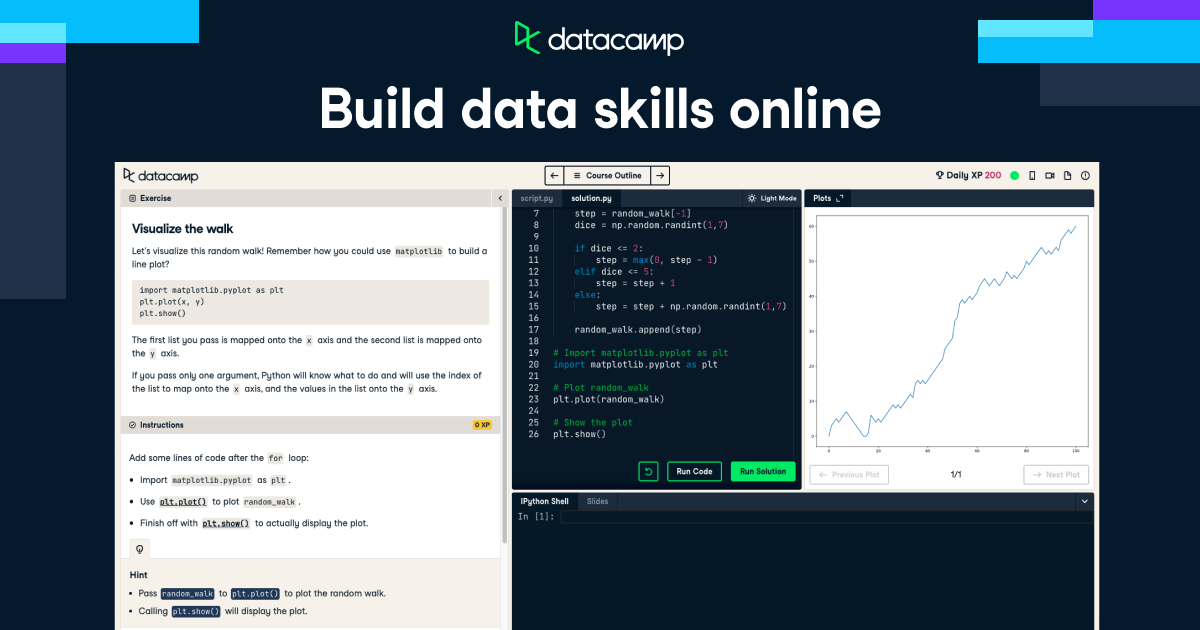
The course is delivered through DataCamp's interactive platform. Short videos alternate with coding exercises, and you can open a live transcript under each video. A glossary and the datasets are provided as resources. The listed length is about four hours, and you can start for free with an account. Most learners will want extra time to retry exercises and experiment on their own, so a few evenings is a realistic pace.
Finishing earns a statement of accomplishment. If you need professional-development credit, the course carries 3 CPE credits, which require a 70% score on the qualifying assessment.
Pros and Cons
Pros
- Covers the full cycle: splitting, fitting, evaluating, tuning, preprocessing, and pipelines
- Uses varied, realistic datasets rather than a single toy example
- Teaches metric selection, which beginners often skip, instead of defaulting to accuracy
- Short enough to finish quickly, with immediate practice after each concept
- Live transcripts and a glossary support different learning styles
Cons
- Four hours means breadth over depth. Each algorithm gets a brief introduction, so you won't build deep intuition for how any of them works internally.
- Exercises are guided and run inside the browser. You get less practice at structuring a project from a blank notebook.
- The pace assumes some comfort with Python and statistics. Learners without that background may need to pause and review first.
- The statement of accomplishment shows that you finished the course. It isn't an exam-based credential, so don't count on it alone to impress employers.
FAQ
Do I need prior experience?
Yes. The course lists Introduction to Statistics in Python as a prerequisite, and you should be comfortable reading and writing basic Python.
Can I try it before committing?
You can start the course for free by creating an account.
Will the certificate help my job search?
It documents that you completed the material. A small portfolio project using the same techniques will likely carry more weight with hiring managers.
What should I take next?
The course appears in several DataCamp tracks, including Machine Learning Fundamentals in Python and Associate Data Scientist in Python. Those are natural next steps if you want a broader sequence.
If the outline matches the skills you want, you can check the current details and begin the first chapter on DataCamp's official course page.