What Is RAG? A Plain-English Guide for Data Professionals
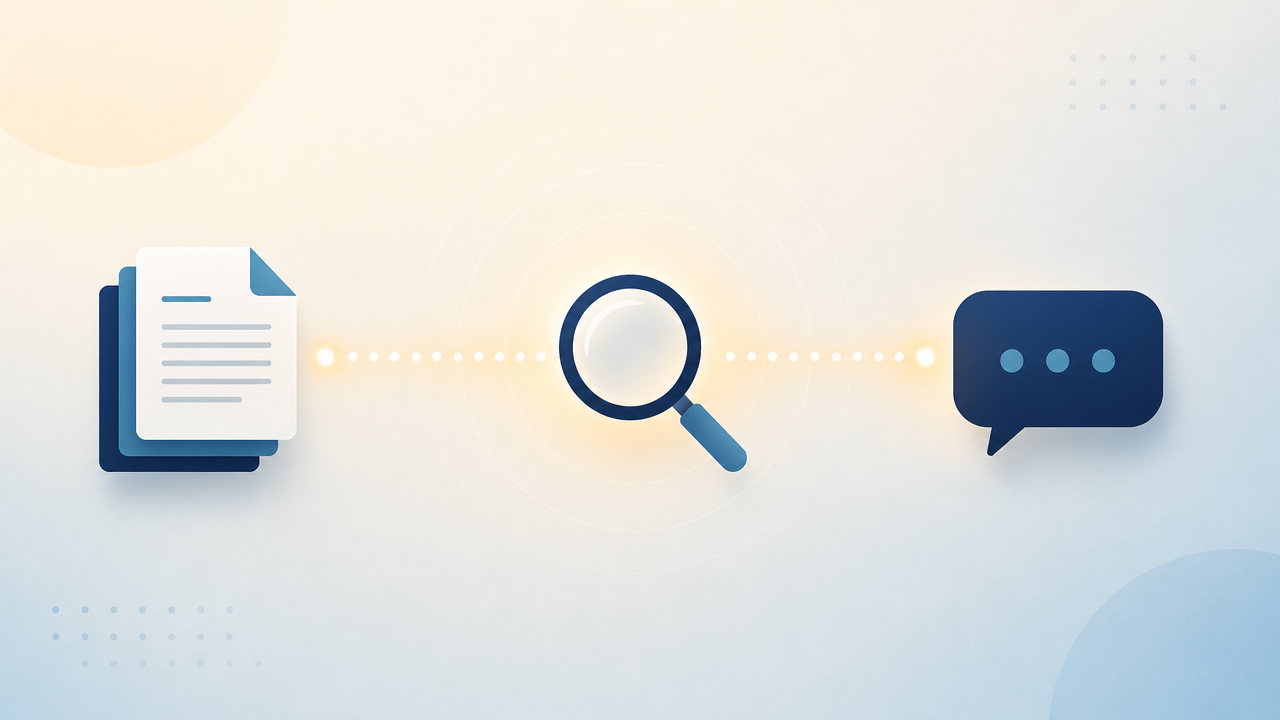
RAG (retrieval-augmented generation) is the pattern behind most real-world LLM applications you interact with — a chatbot that can answer questions about your company's internal documents, a customer support tool that references your actual product manual. Here's what it actually does, explained without assuming you already know the jargon.
The Problem RAG Solves
A language model like ChatGPT only "knows" what it learned during training, up to some cutoff date, plus whatever's included in the conversation itself. It doesn't automatically know about your company's internal wiki, your product's latest documentation, or data that changed after training. Ask it a question about something specific to your organization, and it will either say it doesn't know, or — more concerning — confidently guess at an answer that sounds plausible but is wrong.
RAG fixes this by giving the model access to real, current information at the moment you ask a question, rather than relying only on what it memorized during training.
How RAG Actually Works, Step by Step
Your documents get broken into chunks and converted into embeddings — numerical representations that capture the meaning of each chunk of text, stored in a vector database.
When a question comes in, it also gets converted into an embedding, and the system searches the vector database for the chunks most semantically similar to the question — not just keyword matching, but genuine meaning-based retrieval.
The retrieved chunks get inserted into the prompt sent to the language model, along with the original question — essentially saying "here's some relevant context, now answer this question using it."
The model generates an answer grounded in the retrieved information, rather than relying purely on what it learned during training.
Why This Matters
RAG lets you connect a general-purpose language model to specific, current, or private information without retraining the model itself — which would be slow, expensive, and need to happen every time your documents change. Instead, you update the vector database when your source documents change, and the next query automatically has access to current information.
RAG vs. Fine-Tuning: The Key Difference
These get confused often, but they solve different problems. RAG gives a model access to specific facts and current information at query time. Fine-tuning adjusts the model's underlying behavior — its style, its handling of a specialized task format, its domain-specific reasoning patterns. Many real applications need RAG for facts and don't need fine-tuning at all; fine-tuning becomes relevant when prompting and RAG together still don't achieve consistent output style or behavior for a specialized use case.
What Makes RAG Systems Actually Good or Bad
Retrieval quality matters more than most people expect. If the system retrieves irrelevant or incomplete chunks, the model's answer will be wrong regardless of how good the underlying language model is — the retrieval step is often the actual bottleneck in RAG quality, not the generation step.
Chunk size and overlap strategy matter. Breaking documents into pieces that are too small loses context; too large wastes the model's limited context window on irrelevant text. Getting this right takes real experimentation, not a one-size-fits-all default.
Evaluation is genuinely hard. Because both retrieval and generation can fail independently, and generation is non-deterministic, systematically testing whether a RAG system is actually working well requires deliberate evaluation design, not just spot-checking a few example queries.
Frequently Asked Questions
Do I need to know machine learning to build a RAG system?
Basic Python and API familiarity gets you started; deeper ML knowledge helps with tuning retrieval quality but isn't strictly required for a first working version.
Is RAG the same as just pasting documents into a chat window?
Conceptually similar for a single document, but RAG systems handle much larger document collections automatically, retrieving only the relevant pieces rather than requiring you to manually paste everything into every conversation.
What tools are commonly used to build RAG systems?
LangChain and LlamaIndex are two of the most common frameworks — see our LangChain vs LlamaIndex comparison if you're choosing between them.
RAG is the pattern that lets a language model answer questions using your specific, current information instead of only what it learned during training — retrieve relevant context, then generate an answer grounded in it. It's the foundation behind most practical LLM applications today, and understanding it conceptually is worth doing before diving into the frameworks that implement it.