Book Overview
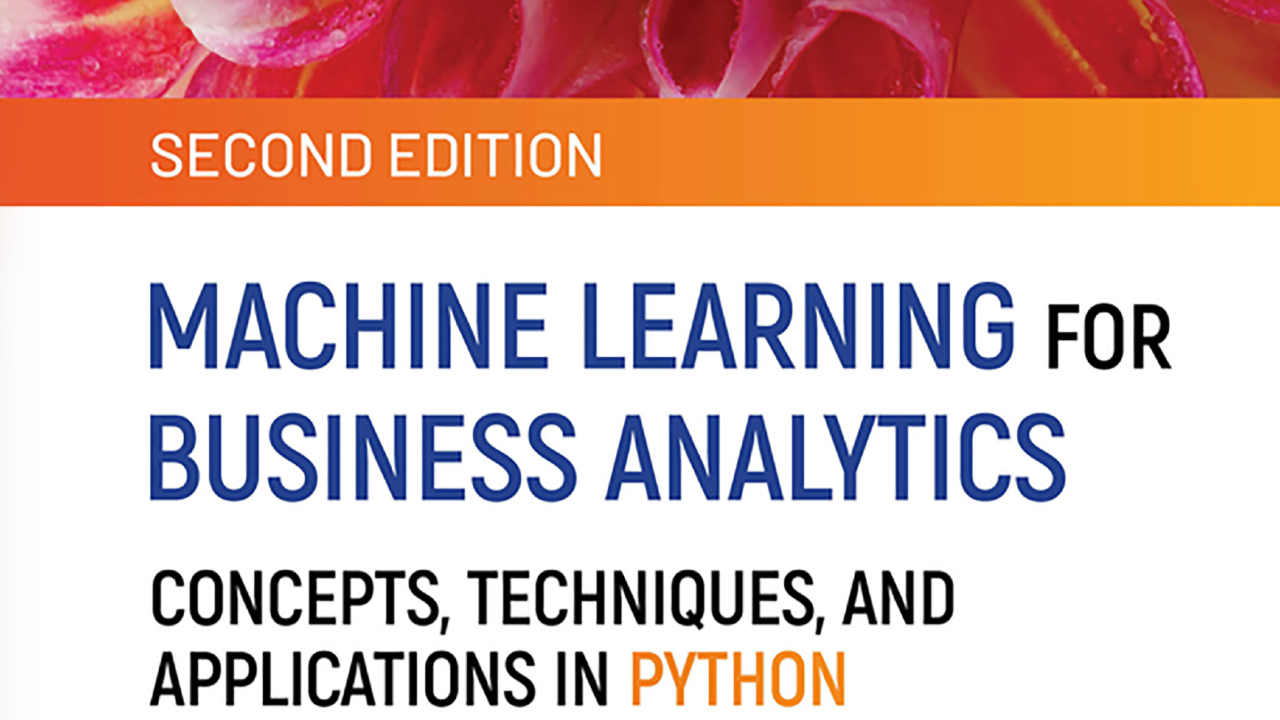
This is a university textbook that teaches machine learning through business problems rather than through mathematics. Each method is introduced by asking what decision it supports, such as which customers to target, how to price, or what to forecast, and then shown on real datasets with Python code. The authors are Galit Shmueli, Peter C. Bruce, Peter Gedeck and Nitin R. Patel, and the series has long been used in MBA and business analytics programs.
The second Python edition, published by Wiley in May 2025, runs to about 720 pages. It keeps the familiar structure, from data exploration through prediction, classification, clustering and forecasting, and adds a chapter on generative AI alongside material on experiments, uplift models and responsible data science. The emphasis throughout is on evaluating models honestly and on matching a method to a business question.
Key Topics Covered
- The machine learning process, data preparation and visualization
- Dimension reduction, including principal component analysis
- Evaluating predictive performance for prediction and classification
- Multiple linear regression, k-nearest neighbors and naive Bayes
- Classification and regression trees, logistic regression and neural networks
- Discriminant analysis and ensembles that combine several models
- Experiments, uplift modeling and an introduction to reinforcement learning
- Association rules, collaborative filtering and cluster analysis
- Time series handling, regression-based forecasting and smoothing methods
- Social network analytics and text mining
- Responsible data science and a new chapter on generative AI
- A set of business cases to practice on
How to Use This Book
This is a reference-style textbook. The early chapters on the machine learning process, visualization and performance evaluation are worth reading first, because later chapters assume them. After that, the method chapters stand largely on their own, so you can jump to logistic regression or clustering when a project needs it. The end-of-chapter problems and the cases at the back are where most of the learning happens; reading without running the code gives far less value.
Who Should Read This
The book suits business analytics and MBA students, analysts moving from Excel or BI tools into predictive modeling, and managers who want to understand what their data science team is doing in enough depth to ask good questions. Basic Python and introductory statistics make it much easier to follow.
Experienced data scientists will find the method coverage introductory and light on the theory behind the algorithms. Readers looking for deep learning engineering or production MLOps should look elsewhere.
Pros and Cons
Pros
- Every method is tied to a business decision, not just a dataset
- Broad coverage, from classic models to uplift, networks, text and generative AI
- Python code and exercises make it practical for self-study
- Strong attention to evaluation and responsible use
Cons
- Long and textbook-priced, which is a lot for a casual reader
- Mathematical explanations are kept brief, so theory-minded readers may want a companion text
- The breadth means some advanced topics get only a short chapter
- Examples follow a classroom style that can feel slower than a project-based course
Frequently Asked Questions
Do I need to know Python first?
Basic Python helps a lot. The book focuses on the analytics, not on teaching the language.
Is this the same as the R edition?
No. The series has editions for different software. This one uses Python.
How does it compare with Hands-On Machine Learning?
Hands-On Machine Learning is more technical and engineering-focused. This book is more about choosing and judging methods for business decisions.
What is new in the second edition?
A chapter on generative AI and updated material across the methods.
Check the current edition and format options on the publisher's page before you buy, as several versions of this series exist.