Book Overview
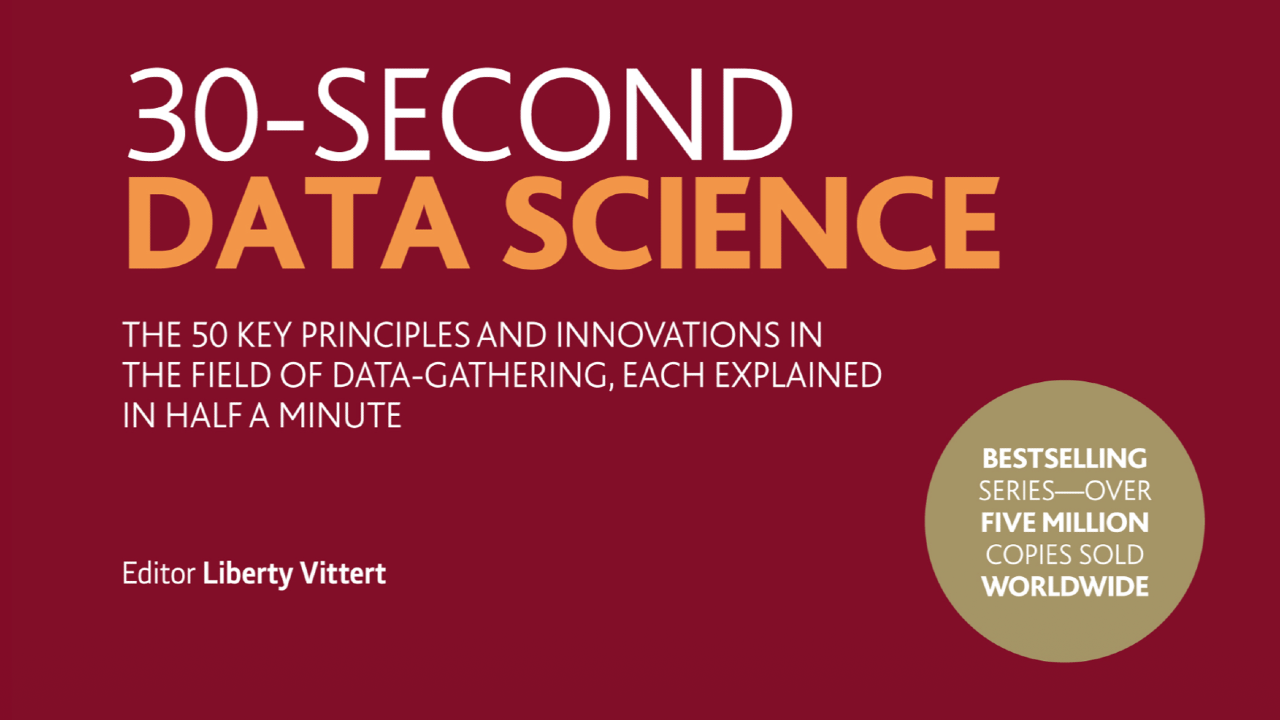
30-Second Data Science belongs to Ivy Press's 30-Second series, where each topic gets a single illustrated spread meant to be read in a few minutes. Edited by statistician Liberty Vittert, a professor of the practice of data science at Washington University in St. Louis, with entries written by a group of contributors, the 160-page hardback was published in September 2020.
The book is less a course than a tour. A short first section explains basic ideas such as data collection, visualization, regression, clustering and neural networks, and a second covers uncertainty: sampling, correlation, confidence intervals, overfitting and bias. The rest shows data science at work in science, society, business and everyday life, with brief profiles of figures such as Florence Nightingale, Ada Lovelace and John Tukey.
Key Topics Covered
- Basics: data collection, visualization, learning from data, tools, regression and clustering
- Statistics, machine learning, neural networks and deep learning
- Uncertainty: sampling, correlation, regression to the mean, confidence intervals, sampling bias and significance
- Bias in algorithms and overfitting
- Science: particle physics, astrophysics, genomics, climate and epidemiology
- Society: surveillance, security, privacy, elections and health
- Business: Industry 4.0, energy, logistics, marketing, finance and product development
- Everyday life: shopping, dating, music, sports, social media, gaming and gambling
- The future: personalized medicine, smart homes, AI, regulation and ethics
- Profiles of historical pioneers and a glossary for each section
How to Use This Book
This is a reference to dip into. Entries are self-contained, so you can open it at any page, read one idea in a few minutes and move on. Reading the Basics and Uncertainty sections first gives the vocabulary that the application entries use, but it is not essential. Each section opens with a short glossary, so it is worth scanning that page before the entries. For a classroom or study group, a single entry makes a good warm-up: read it together, then ask where the same idea shows up in your own work or data. If an entry sparks real interest, follow it up with a full guide or course on that topic, since the book deliberately stops after the core idea.
Who Should Read This
The book suits curious beginners, students deciding whether to study data science, managers who want a quick sense of the field, and teachers looking for short readings to spark discussion. It also makes a good gift for non-specialists.
It will not teach you to do data science. There are no exercises, no code and only brief explanations of methods, so anyone who already works with data will find it too light.
Pros and Cons
Pros
- Very short, illustrated entries that are easy to read in spare minutes
- Wide range of real-world applications across science, business and daily life
- Profiles of pioneers add historical context
- Section glossaries help newcomers with vocabulary
Cons
- Each topic gets only a page or two, so explanations stay at a surface level
- Published in 2020, it predates the generative AI wave
- No exercises or practical guidance
- Several editions and ISBNs exist, which can be confusing when buying
Frequently Asked Questions
Is this book for beginners?
Yes. It assumes no background in statistics or programming.
Does it cover generative AI?
No. It was published in 2020, before tools like ChatGPT became widespread.
How does it compare with Naked Statistics?
Naked Statistics explains statistical reasoning in more depth through longer stories. This book covers more topics in much less detail.
Is it a textbook?
No. It is an illustrated primer for general readers.
Check current editions and prices if you want a light, illustrated introduction to share with someone new to data.