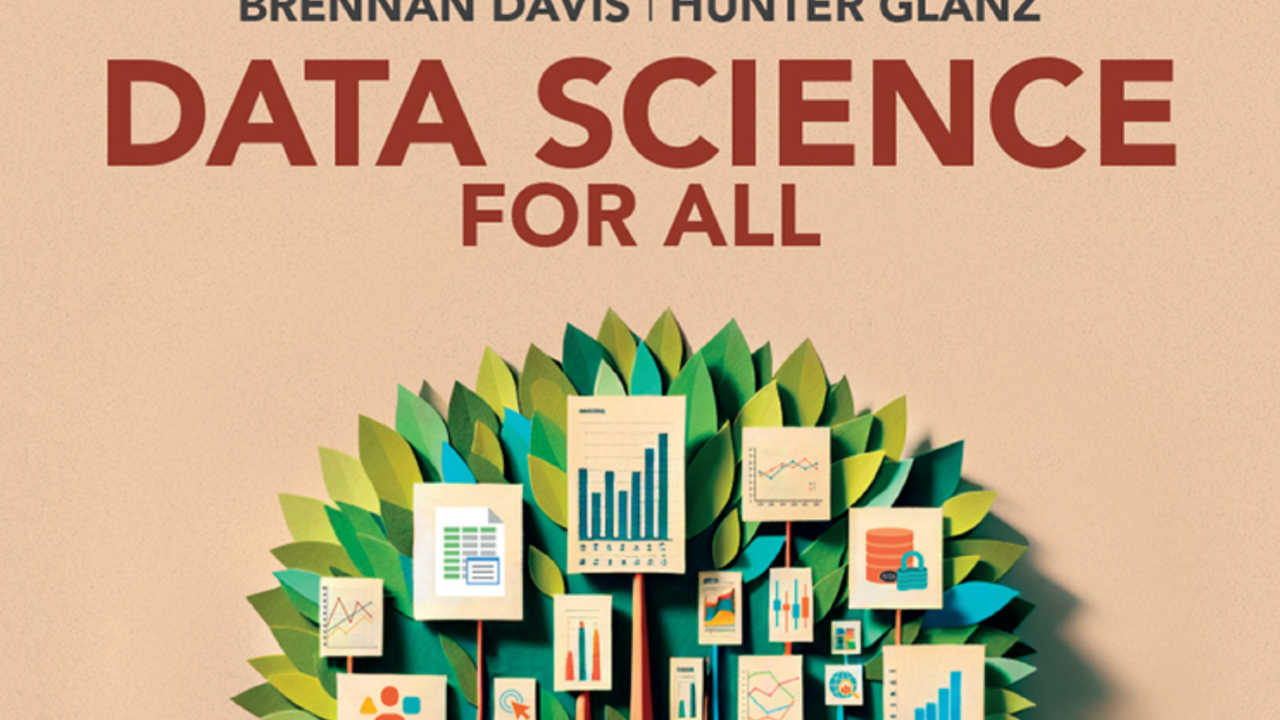
Book Overview
Data Science for All is an introductory textbook from Pearson by Brennan Davis and Hunter Glanz of California Polytechnic State University, first published in December 2024. It is written for students taking their first data science course, often without a strong maths or programming background, and it follows the full workflow: getting data into shape, exploring and visualizing it, drawing careful conclusions, and building simple machine learning models.
Where many introductory statistics books focus on formulas, this one starts with tables of real data and asks what story they can tell. Each chapter mixes explanation with short practice activities, review questions and a tech center section for hands-on software work, and each one ends with an ethics discussion, such as the risks of visual misrepresentation, data privacy rules, p-hacking or bias in machine learning.
Key Topics Covered
- What data science is, data in tables, data preparation and storytelling
- Data wrangling: missing data, anomalous values, transforming variables, reshaping and combining datasets
- Visualization, from the grammar of graphics to guidelines for honest charts
- Exploratory data analysis: center, spread, shape, associations and outliers
- Data management: selecting, filtering, summarizing and merging tables
- Uncertainty, probability, sampling methods and simulation
- Statistical inference, study design and A/B testing
- Machine learning foundations, evaluation and an introduction to deep learning
- Supervised learning with linear regression, nonparametric models and classification
- Unsupervised learning with k-means and hierarchical clustering
How to Use This Book
It is a first read built for a semester course, and it rewards working through it in order. The first five chapters build practical data skills; the middle chapters on uncertainty and inference are where the book shifts from describing data to drawing conclusions; the final chapters on machine learning depend on both. The activities and the answers in the appendices make it usable for self-study as well as in class.
Who Should Read This
The book suits university students in a first data science course, career changers who want a structured introduction, and teachers looking for an accessible textbook with built-in ethics content. No prior statistics is assumed.
Readers who already know statistics or have worked with pandas or R will find it slow. It is also a broad introduction rather than a deep guide to any single tool or algorithm.
Pros and Cons
Pros
- Beginner-friendly, starting from real tables rather than formulas
- Covers the whole workflow, from wrangling to machine learning
- Ethics discussion in every chapter
- Practice activities and review questions with answers
Cons
- Long, at over 500 pages, for readers who want a quick overview
- Machine learning coverage stays introductory
- Textbook pricing and multiple editions (US and Global) make buying less straightforward
- Some features are tied to Pearson's online platform rather than the book itself
Frequently Asked Questions
Do I need maths or coding experience?
No. It is written for first-time learners.
Is there a Global Edition?
Yes. Pearson also sells a Global Edition, so check which version your course uses.
How does it compare with Naked Statistics?
Naked Statistics is a popular-science read about statistics. Data Science for All is a full textbook with exercises across the data science workflow.
Does it cover machine learning?
Yes, at an introductory level, including regression, classification and clustering.
Check the available print and eText options on Pearson's page to pick the edition that matches your course.